

Insights from ai-PULSE 2025: Building for Real-world Deployment
At ai-PULSE 2025, leaders across industries showed what happens when AI is deployed into real-world environments. This article brings together the key insights from these sessions.
For decades, robotics promised intelligent machines. In 2025, that promise is starting to materialize.
At ai-PULSE 2025, robotics emerged as one of the clearest signals that foundation models are escaping the lab and entering the physical world. Advances in perception, reasoning, and multimodal interaction are turning decades of research into deployable systems — not just in factories, but in hospitals, public spaces, and everyday environments.
Across keynotes and live demonstrations, founders and CTOs explored what it takes to move from impressive demos to reliable, general-purpose machines: hybrid cloud-edge architectures, long-horizon robustness, dexterity, safety, and emotional intelligence by design.
This article distills the main lessons from these sessions — and examines how Europe is positioning itself to build the next generation of embodied AI.
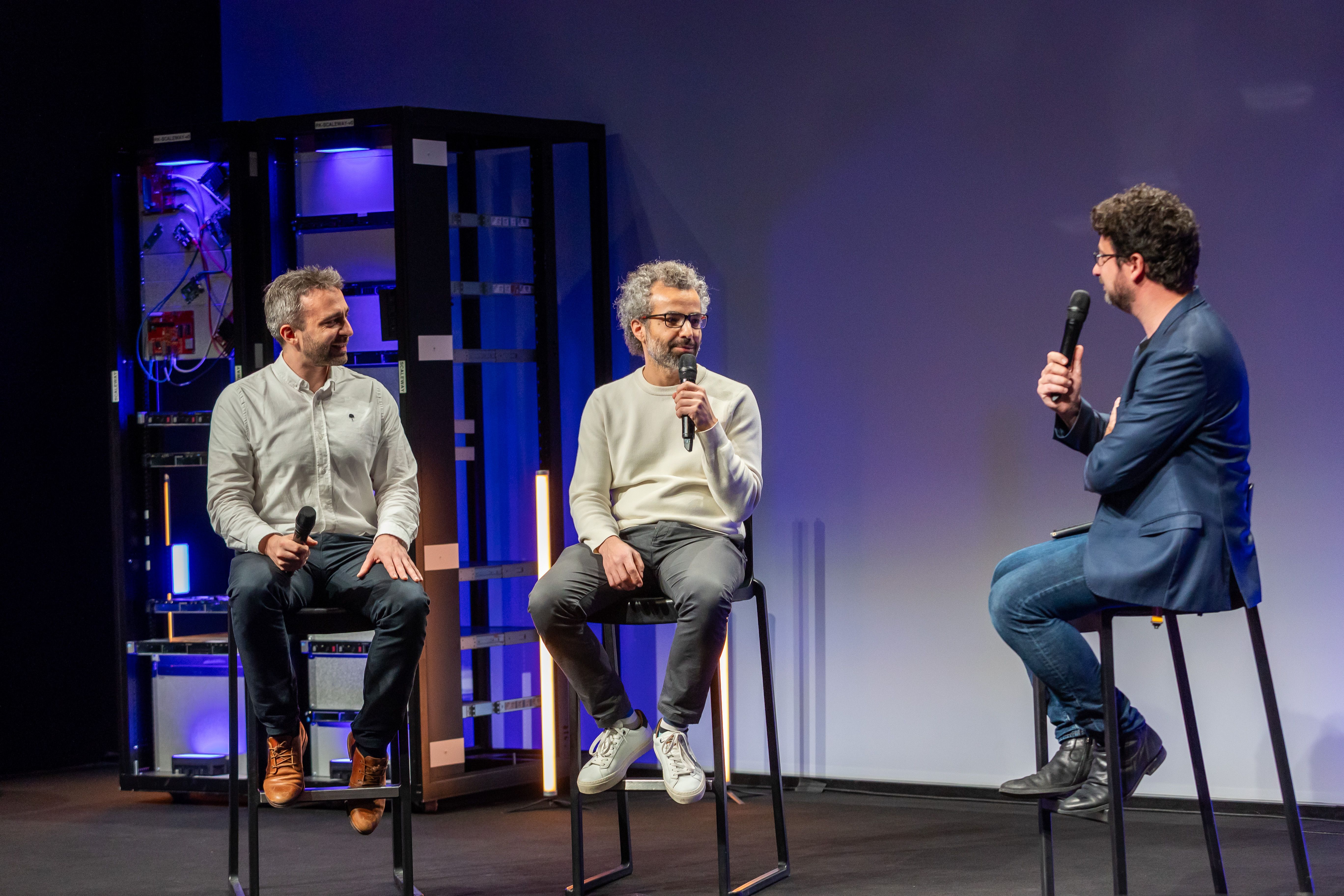
Jean-Baptiste Kempf, CTO, Scaleway
Firas Abi Farraj, CTO, Enchanted Tools
Grégoire Linard, CTO, Enchanted Tools
This panel examined how recent AI advances are finally turning robotics into a deployable reality beyond labs and factories. Enchanted Tools’ Firas Abi Farraj and Grégoire Linard framed robotics as a deeply interdisciplinary effort spanning AI, hardware, navigation, and UX — the reason why the company opted to have three CTOs, each covering a critical layer of the stack.
A central question was why AI has become a game changer now, after decades of robotics research. Abi Farraj traced a clear sequence. Deep learning first made perception viable. Reinforcement learning then delivered robustness in the real world — as seen in DARPA challenges. More recently, LLMs, VLMs, and world models “scaled the acceleration much faster.” The result is a shift from isolated demos to systems that can handle complexity over time.
Reliability remains the hard constraint. “An error in a robotic AI… it’s not a typo. It’s an avalanche,” because small mistakes compound across long-horizon tasks until failure. To manage this, robots must rely on layered, hybrid architectures: cloud models for reasoning and planning, paired with many small on-device models for perception, speech, and control, connected through “a controlled interface” that can be tested and certified.
Beyond function, adoption will depend on emotion. If robots are to live alongside people, they must adapt their behavior to context — children, older adults, care settings. (▶️ Watch session in full)
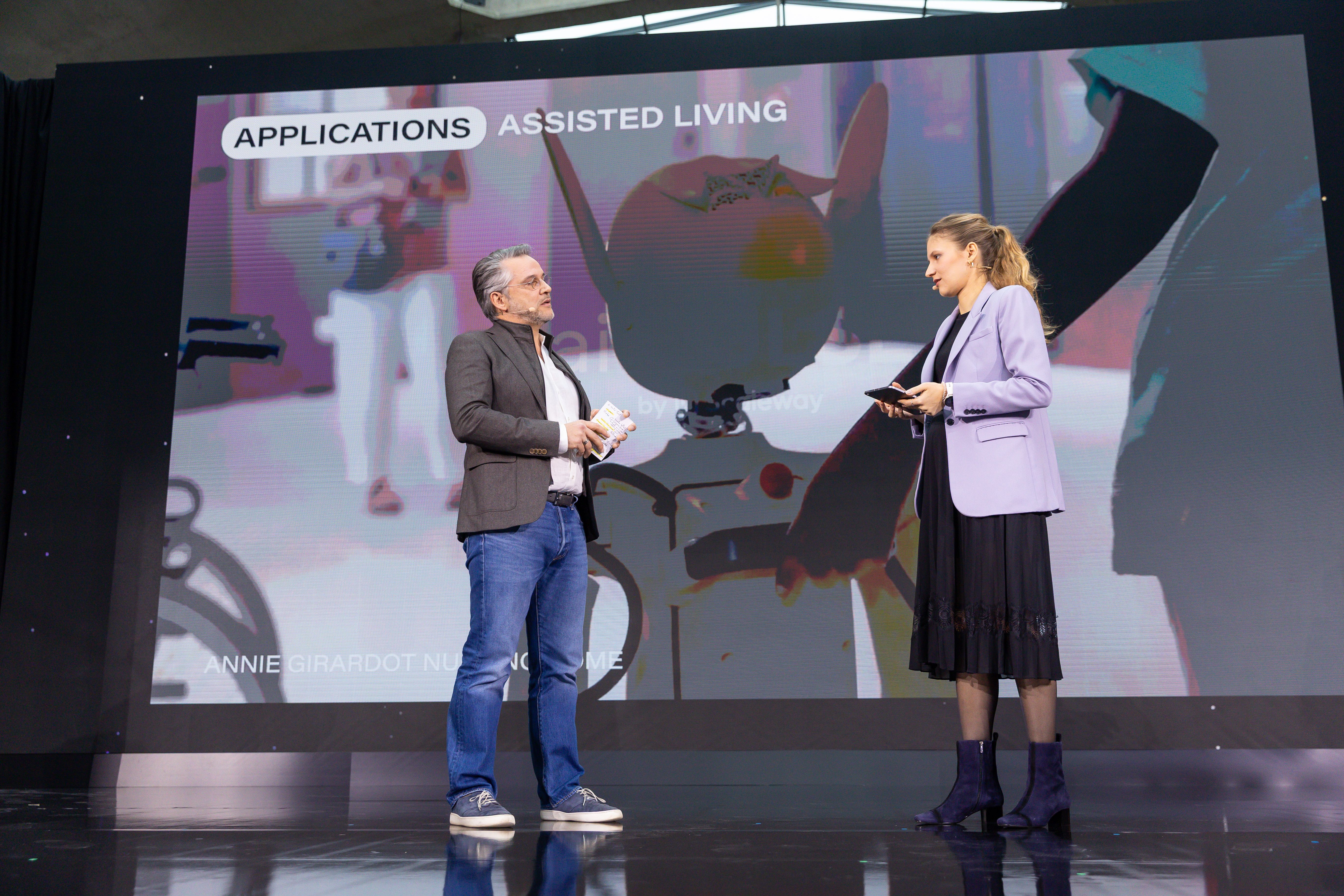
After a theatrical entrance by Mirokai, Enchanted Tools’ social humanoid robot, cofounder and CEO Jérôme Monceaux stepped on stage to explain the philosophy behind its design: robots meant for real human environments require empathy, anticipation, and safety by design, not just mechanical strength. Drawing on 20 years of robotics work — from Aldebaran’s NAO and Pepper to today’s Mirokai — Monceaux framed humanoid robotics as a social technology, not an industrial one.
Mirokai is powered by Gemini Live and a suite of onboard machine-learning models enabling multimodal perception, emotion reading, and real-time behavioral synthesis. But the real magic lies in human-robot interaction. Monceaux described seemingly simple gestures — handing an object to a child, anticipating when to release it, responding to micro-expressions — as some of the hardest problems in robotics. Success, he argued, depends less on complexity and more on “designing the dance between the robot and the user.”
To illustrate, Monceaux proudly described a medical deployment now underway at ICM: using Mirokai to assist children undergoing radiotherapy. In a setting where parents cannot enter the treatment room, the robot’s presence has transformed a distressing, hour-long process into one that is calmer, faster, and sometimes even joyful. This emotional shift, in turn, resulted in a "10x factor in the productivity of the machine." The story offers a critical lesson: the value of emotional robotics isn't just in utility, but in how their ability to provide emotional support can create tangible, productive outcomes. (▶️ Watch session in full)
ai-PULSE 2025 provided a stage for a momentous newcomer in the realm of robotics: UMA, presented by founder and CEO Rémi Cadene. UMA (short for Universal Mechanical Assistant) aims to build general-purpose humanoid and mobile robots designed to work safely and autonomously alongside humans — an ambition shaped by Cadène’s years working on robotics at Tesla and, most recently, Hugging Face.
For Cadene, the frontier is clear: dexterity. Robots must graduate from structured demos to messy real-world manipulation — folding laundry, brewing coffee, packing boxes. Achieving this requires lightweight, safe hardware and neural architectures that learn from human demonstrations and self-improve through practice, much like autonomous driving systems evolved from rule-based systems to end-to-end learning.
Cadene argued passionately that Europe is the best market to build a robotics leader: it has strong industrial ecosystems, world-class engineering education (at accessible cost!), and a demographic imperative for automation given its aging population. UMA will combine an agnostic AI “brain” with its own European-controlled supply chain for hardware. This was the morning’s clearest statement that Europe’s sovereignty shouldn’t stop at software. (▶️ Watch session in full)
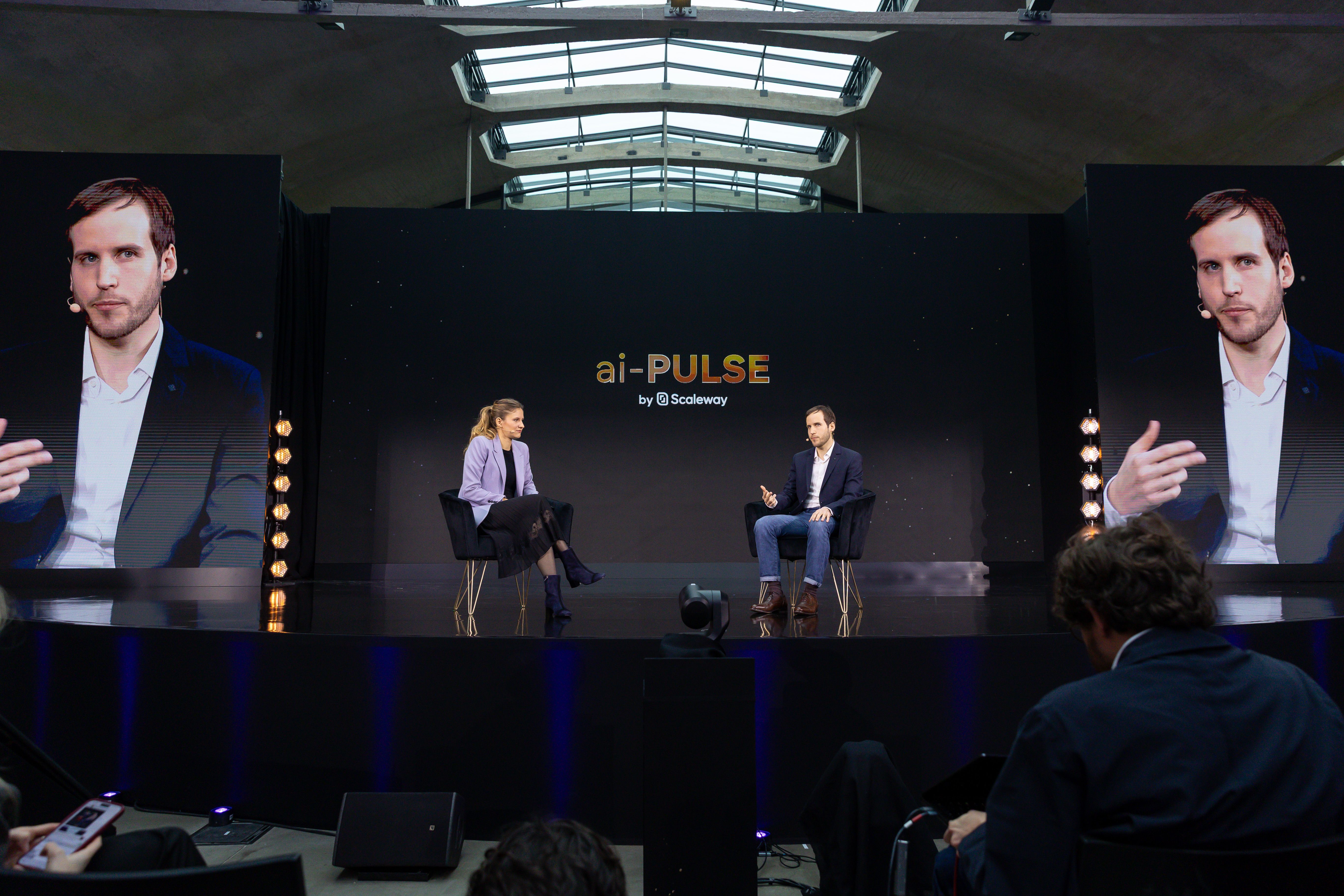
On December 4, 2025 we hosted the third edition of ai-PULSE, Europe's premier AI conference.
With 1,600+ people gathered at STATION F in Paris and thousands more joining online, this was our biggest and most ambitious edition yet — a place where leading researchers, founders, and builders from Europe and beyond came to explore where AI is heading next.
If you couldn’t follow everything live, our white paper captures the key takeaways from across 30+ sessions into one structured recap.
At ai-PULSE 2025, leaders across industries showed what happens when AI is deployed into real-world environments. This article brings together the key insights from these sessions.
From novel translation architectures to open voice and video systems, ai-PULSE 2025 explored how AI is being applied across modalities. This article distills the key insights from these sessions.
At ai-PULSE 2025, builders shared what it takes to move agentic AI from demo to production. This article distills key architectural insights for scaling agentic systems with control and resilience.