
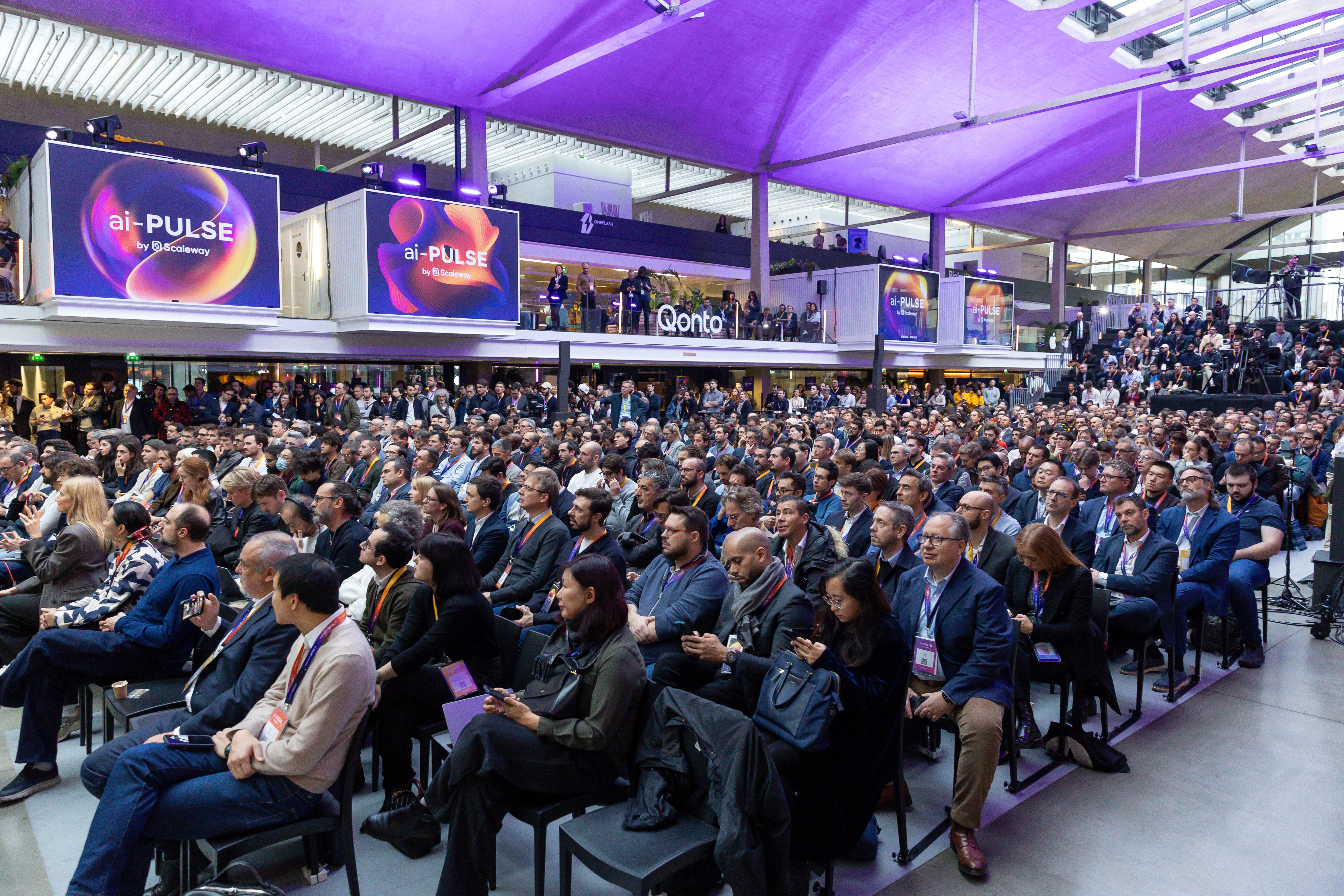
ai-PULSE 2025: Inside the Ideas and Announcements Shaping the Next Era of AI
A look inside the breakthrough ideas and announcements that defined ai-PULSE 2025 — from world models to robotics, voice AI, and Europe’s growing momentum.

AI is getting smarter and faster. But it is also getting heavier.
As models grow in size, reasoning depth, and multimodal complexity, and as organizations of every scale ramp up inference and training workloads, the environmental cost of AI has become impossible to ignore. No longer just a performance question, compute is an energy and transparency challenge.
At ai-PULSE 2025, several sessions tackled what may be AI’s most pressing long-term constraint: sustainability. From standardized model energy benchmarks to real-world carbon accounting, from hardware trade-offs to liquid cooling architectures, speakers converged on a common idea: efficiency must become a first-class metric of AI innovation.
This article brings together the key insights from these sessions, and outlines what it will take to build AI that scales responsibly.
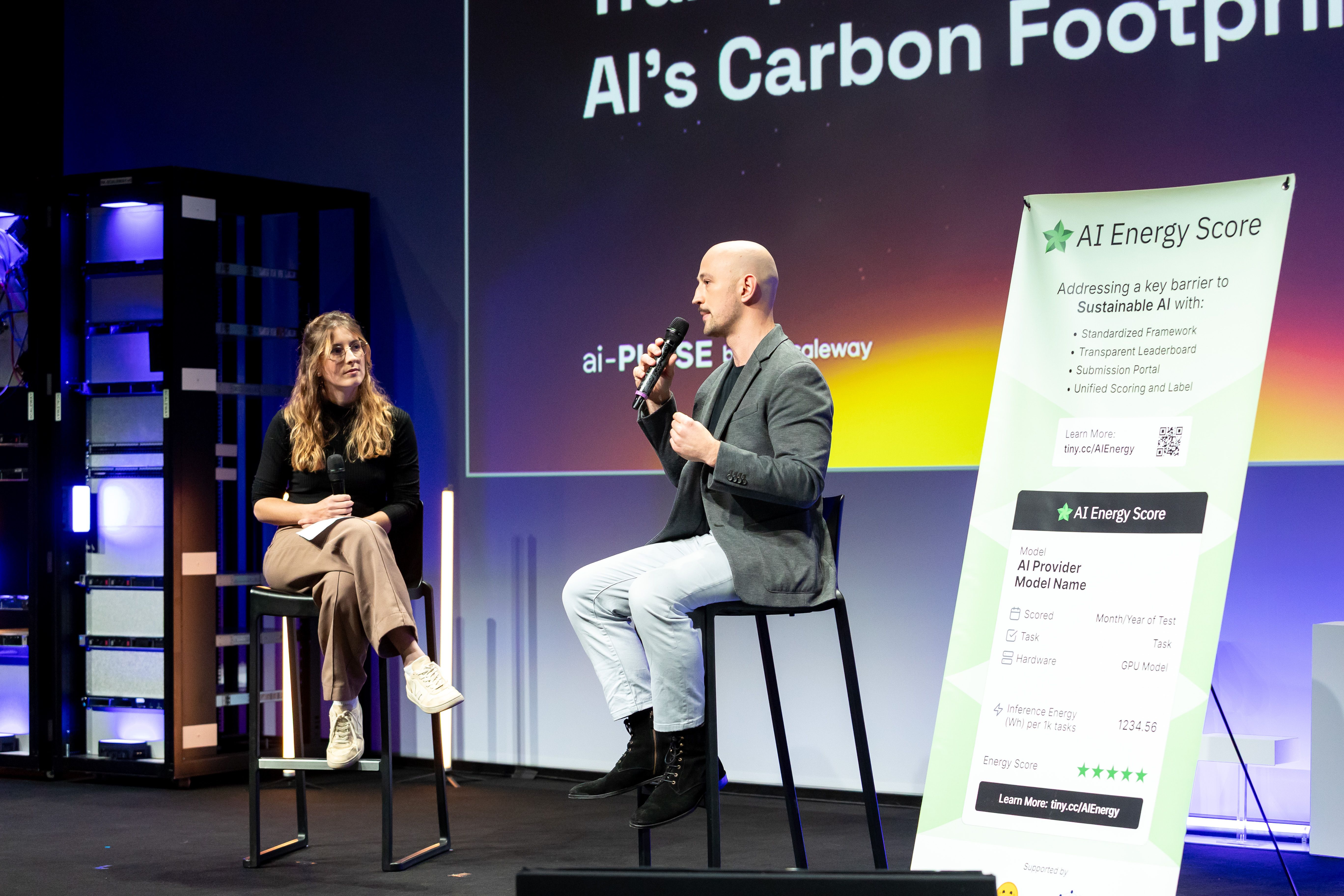
Elise Auvray, Product Manager - Environmental Footprint, Scaleway
Boris Gamazaychikov, Head of AI Sustainability, Salesforce
This session focused on what the speakers called “the elephant in the server room”: the environmental footprint of AI, and the long-standing lack of transparency around inference. As models grow more capable, they are often deployed “without imagining the environmental footprints they can generate,” making sustainability impossible to manage without measurement.
Salesforce’s Head of AI Sustainability Boris Gamazaychikov introduced the AI Energy Score, a standardized benchmark created with partners including Hugging Face to compare the energy efficiency of AI models under fixed conditions. By holding hardware and evaluation settings constant, the score isolates model behavior and reveals large efficiency gaps between architectures. With the rise of reasoning models, a new version adapts the benchmark to systems whose token usage and behavior differ sharply from earlier LLMs. As Boris Gamazaychikov explained, “This lack of transparency is a foundational blocker to us being able to take the right steps towards sustainability.”
Elise Auvray, Product Manager at Scaleway, presented the company’s Environmental Footprint Calculator as the production-side complement. Rather than benchmarking models in isolation, it measures the real environmental impact of cloud usage across the full lifecycle of infrastructure, from manufacturing to operations and end of life. Auvray framed the distinction simply: the Energy Score captures theoretical efficiency, while Scaleway measures “how much fuel you actually burn in the real world.”
Together, the session argued that sustainability becomes truly actionable when energy use is made visible — enabling concrete gains through smarter model selection, leaner prompting, and informed deployment choices. (▶️ Watch session in full)
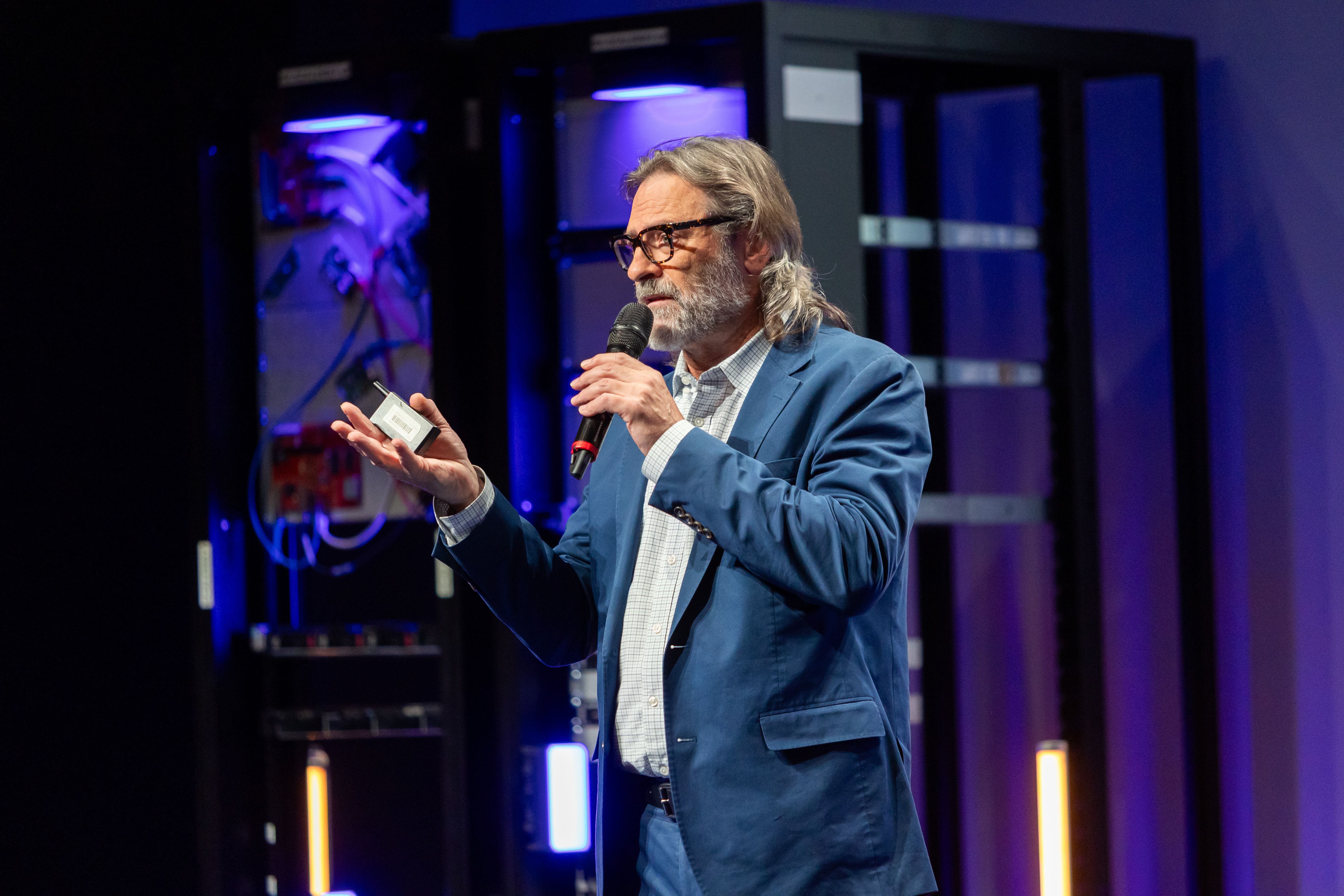
In this session, Sean Varley, Chief Evangelist & VP of Business Development at Ampere Computing, took a bottom-up view of AI scaling. The real bottleneck, he argued, is no longer model innovation alone, but the economics and energy profile of the underlying infrastructure. Varley pointed to a structural imbalance: although GenAI is expected to represent less than 40% of total workloads by 2030, it could consume roughly 70% of data-center power. The result is a system where AI disproportionately drives cost and energy demand, forcing infrastructure teams to rethink how compute is allocated.
Varley showed how the rapid growth of smaller, specialized models — often used in agentic and multimodal systems — is shifting inference economics. As parameter counts rise, costs scale sharply, pushing teams to favor compact “expert” models that can run more cheaply and at higher volume. On this lower end of the spectrum, CPUs re-emerge as a viable alternative to GPUs, especially when power budgets and operational cost dominate design constraints.
Comparing Ampere Arm-based CPUs with x86 processors and GPUs, Varley highlighted gains in price-performance and energy efficiency, emphasizing metrics like performance per rack and tokens per watt. As he puts it, “a GPU is kind of a sledgehammer” for smaller models, while CPU platforms allow many models to run in parallel at far lower operational cost. The core takeaway: scaling AI sustainably means optimizing for “performance per euro” rather than raw compute alone. (▶️ Watch session in full)
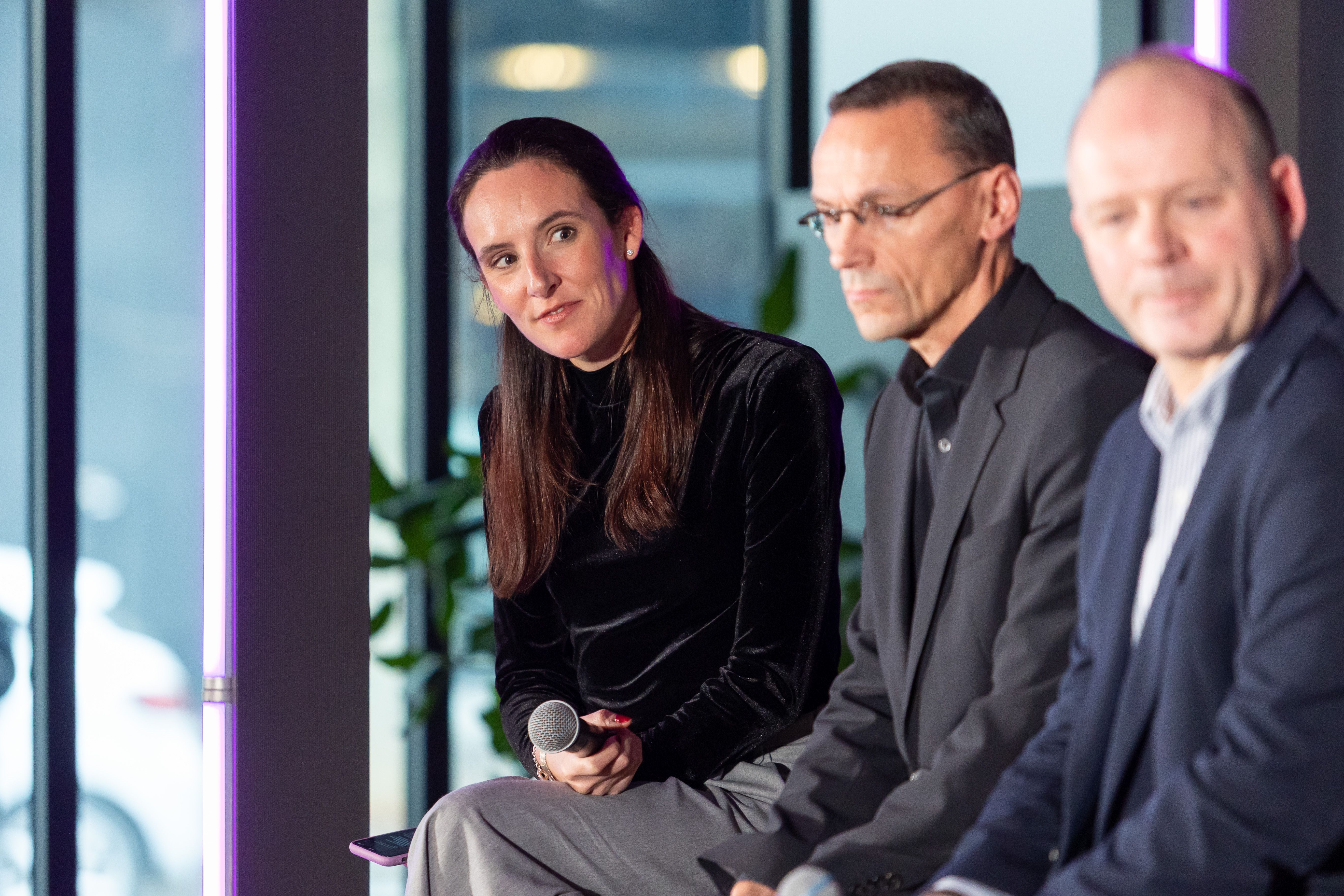
Albert Tsai, BD, Sr. Director, Giga Computing
Christophe Lacroix, CINO & CSO, Motul
Frédéric Petit, Research & Innovation Director, VALEO
Bruno Lecointe, Group VP HPC, AI & Quantum business, Eviden
Albane Bruyas, COO, Scaleway
As GPU power densities accelerate, cooling is becoming a first-order constraint for AI infrastructure. Opening the session, Scaleway COO Albane Bruyas framed cooling as a system-wide challenge, spanning chips, servers, racks, and entire data centers.
From an HPC perspective, Bruno Lecointe (Group VP HPC, AI & Quantum, Eviden) emphasized that performance must be assessed through efficiency rather than peak compute alone. Drawing on Green500 results, he explained that direct liquid cooling enables “5 to 8% better efficiency than the competition,” arguing that this matters more than headline Top500 rankings when systems operate at tens or hundreds of megawatts. He also highlighted the advantages of hot-water cooling architectures designed end-to-end.
At the hardware level, Albert Tsai (Giga Computing) detailed how rising thermal constraints are forcing fundamental redesigns, recalling that GPUs were at just 700 watts only a few years ago, versus more than 2 kW ahead. No longer limited to CPUs and GPUs, cooling has come to encompass networking, memory, and power delivery components.
Finally, Christophe Lacroix (Motul) and Frédéric Petit (Valeo) showed how automotive expertise in batteries, fluids, and thermal management is being applied directly into data centers. Their contributions underscored that no single cooling solution fits all use cases: air, rear-door, direct-to-chip, two-phase, and immersion each serve distinct operational needs. In any case, thermal architecture and maintenance is poised to be central to future AI performance. (▶️ Watch session in full)
Cas Burggraaf, CTO, GreenPT
Robert Keus, CEO & Co-Founder, GreenPT
GreenPT’s session kicked off with a clear claim: “sustainable AI doesn’t exist” — only AI that can be made as sustainable as possible through transparency and control. Robert Keus and Cas Burggraaf argued that the real issue is not just AI’s rising energy use, but the absence of verifiable data from mainstream providers on where models run and what they actually consume.
GreenPT’s response to this challenge is full-stack ownership. By self-hosting models on bare-metal GPUs, the company measures real-time energy usage at the hardware level and exposes it to users via dashboards and APIs. This enables a concrete metric — milliwatt-hours per 100 tokens — that connects model performance to actual infrastructure.
Sustainability, the team stressed, is also a product decision. Frontier models are often unnecessary — “using GPT, for many tasks, is like driving a Ferrari to do groceries” — and careful model selection, prompt design, and output-token control can significantly reduce compute. GreenPT’s approach matches hardware to actual workloads, favors midsize and smaller models when sufficient, and optimizes infrastructure choices end to end.
The last piece of the puzzle has to do with location. By running infrastructure in France, GreenPT benefits from a lower-carbon electricity mix, reinforcing that sustainable AI is a multifaceted problem. (▶️ Watch session in full)
On December 4, 2025 we hosted the third edition of ai-PULSE, Europe's premier AI conference.
With 1,600+ people gathered at STATION F in Paris and thousands more joining online, this was our biggest and most ambitious edition yet — a place where leading researchers, founders, and builders from Europe and beyond came to explore where AI is heading next.
If you couldn’t follow everything live, our white paper captures the key takeaways from across 30+ sessions into one structured recap.

A look inside the breakthrough ideas and announcements that defined ai-PULSE 2025 — from world models to robotics, voice AI, and Europe’s growing momentum.
At ai-PULSE 2025, builders shared what it takes to move agentic AI from demo to production. This article distills key architectural insights for scaling agentic systems with control and resilience.
From novel translation architectures to open voice and video systems, ai-PULSE 2025 explored how AI is being applied across modalities. This article distills the key insights from these sessions.
At ai-PULSE 2025, leaders across industries showed what happens when AI is deployed into real-world environments. This article brings together the key insights from these sessions.