

Domain names: who does what among registry, registrar and hosting provider?
Explore the relationship between the registry, registrar, and hosting provider, and see why knowing the difference is vital for your domain management and DNS security.
Every website address ends with one, yet the top-level domain is one of the most misunderstood pieces of internet infrastructure. It shapes how traffic is routed, who is allowed to register a name, and how search engines interpret your geographic reach. Before choosing an extension for your next project, it helps to answer a few questions:
This guide covers what a TLD is, the main categories, how they resolve through the DNS, and how to choose one.
A Top-Level Domain (TLD) is the last segment of a domain name, located after the final dot, such as .com, .org, or .fr. In the Domain Name System (DNS), the TLD represents the highest level of the domain hierarchy. It sits just below the root zone and plays a critical role in how internet traffic is routed and resolved.
A domain like www.example.com is structured in layers. .com is the TLD; example is the second-level domain (SLD), the part you actually register and that carries your brand; and www is a subdomain (a host under your second-level domain). This layered structure is what allows a DNS to translate human-readable names into the IP addresses that servers understand.
In several countries, registrations were historically restricted to the third level, rather than being open directly under the TLD. In the United Kingdom, you registered under .co.uk (as in example.co.uk), and in Australia, under .com.au, with your actual label sitting one level further to the left. Both registries have since opened direct second-level registration (.uk in 2014, .au in 2022), though the older third-level form remains very widely used.
In practice, the TLD is not just a naming convention. It is a functional component of global internet infrastructure.
More than 1,500 TLDs are now delegated in the root zone. They fall into two main families, generic extensions and country-based extensions, plus a few more specialized categories.
Generic Top-Level Domains represent the most flexible category of domain extensions. The original set, known as legacy gTLDs (.com, .net, .org), was small, but the ecosystem expanded dramatically after ICANN launched its New gTLD Program in 2012, adding more than 1,200 new extensions to the root zone.
Today, gTLDs include hundreds of options such as .tech, .shop, .digital, or .app. These newer extensions are often used for branding, allowing companies to position themselves within a specific industry or niche. A new application round is currently open (from 30 April to 12 August 2026), which will expand the list further.
Country-Code Top-Level Domains are two-letter extensions assigned to specific countries or territories, based on the ISO 3166-1 country codes. A .fr domain corresponds to France, .de to Germany, .jp to Japan, and so on. This national association is usually fixed and cannot be reassigned to another country.
However, some ccTLDs are now marketed and used globally, with little practical connection to their countries or territories of origin:
All four are commonly used as if they were generic, despite officially belonging to a specific territory.
Sponsored Top-Level Domains are specialized extensions managed by specific organizations and subject to strict eligibility rules.
Examples include .edu, restricted to accredited educational institutions, and .gov, reserved for government entities. Note that these two are essentially US-specific: .edu is limited to US-accredited institutions and .gov to US government bodies. Other countries use their own equivalents at the second level, such as .gouv.fr, .ac.uk, or .edu.au.
Because they are not open for public registration, sTLDs carry a high level of trust and authority, for both users and search engines, and are often associated with institutional legitimacy and high-quality sources.
The 2012 expansion also gave rise to brand TLDs: extensions owned and operated by a single organization for its own use, such as .google or .leclerc. They are not open to public registration and are used to build fully brand-controlled, secure digital ecosystems.
TLDs are no longer limited to the Latin alphabet. Internationalized Domain Names allow extensions in native scripts, for example .рф (Cyrillic, Russia), .中国 (Chinese, China), or .みんな (Japanese). IDNs make the web more accessible to non-Latin-script audiences and are an important part of the modern TLD landscape.
Understanding who does what removes a lot of the confusion between gTLDs and ccTLDs:
- ICANN (Internet Corporation for Assigned Names and Numbers) sets the overall policy and runs the program that creates new gTLDs.
- IANA (Internet Assigned Numbers Authority), operated under ICANN, maintains the root zone, the authoritative list of every delegated TLD.
- Registries operate individual TLDs. Verisign runs .com and .net; Afnic runs .fr. Each ccTLD is delegated to a designated operator, national in most cases or supranational (EURid runs .eu).
- Registrars are the accredited companies through which you actually buy and manage a domain.
- Registrants are the individuals or organizations that hold the domain.
In short: ICANN and IANA govern the namespace, registries operate each extension, and registrars are your point of purchase and management.
When a user enters a domain name into a browser, the TLD becomes a key part of the DNS resolution process.
The request first goes to a DNS resolver, which queries the root DNS servers if it doesn't already have the answer cached. These root servers do not provide the final IP address, but they know which TLD registry is responsible for the requested extension.
For a .eu domain, the request is forwarded to the .eu registry, which points the resolver to the authoritative nameserver for the domain. The nameserver finally returns the IP address of the server hosting the website.
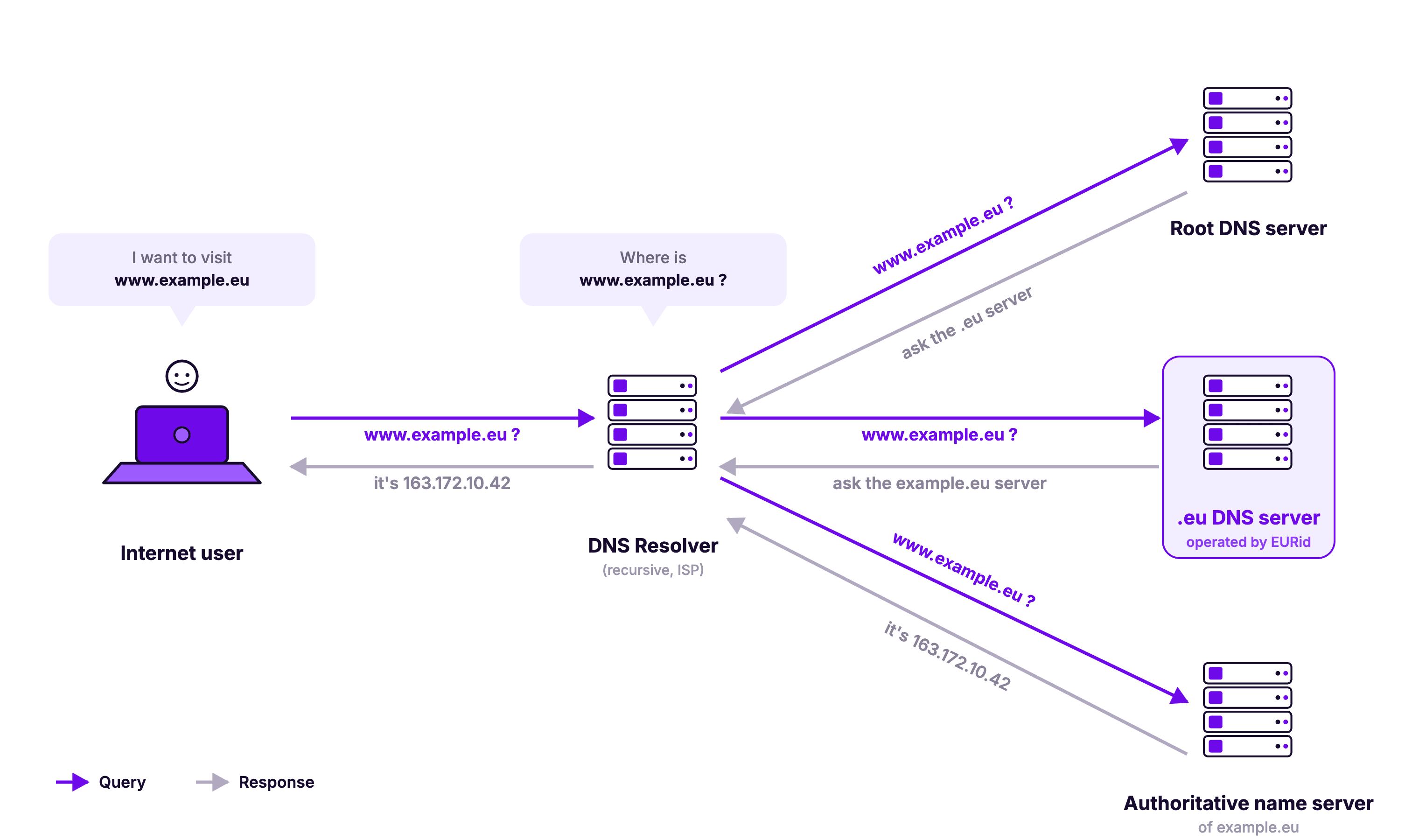
Caching keeps this fast: resolvers store answers for a defined period (the Time to Live - TTL), so most lookups never travel all the way back to the root. That is what keeps resolution to a few milliseconds and reduces load on the global infrastructure.
TLDs are not a direct ranking factor, but they influence SEO in a few indirect ways, and it's worth being precise about what actually helps.
Geographic targeting. A genuine ccTLD like .fr or .de is a strong local signal: search engines read it as targeting that country. The exception is the country codes used globally, since Google treats .io, .ai, .co, .tv, .me, and .fm (gccTLDs) as generic, with no geographic signal.
gTLDs carry no country signal either, and since Search Console's manual country targeting was retired, you steer geography through localized content, hreflang, and URL structure.
No keyword bonus. A keyword-rich extension like .shop or .tech does not help you rank for that keyword, and matching the extension to your topic doesn't improve relevance. Google has stated that keywords in a TLD give no ranking advantage or disadvantage. Their value is branding, not SEO.
User trust and branding. Extensions carry perception signals: .com reads as standard, .org or .edu as authoritative. This can lift click-through rates and indirectly affect performance, but it is a behavioral signal, not a ranking mechanism.
Choosing a TLD sits at the intersection of SEO, branding, and business strategy.
Global reach: .com remains the most reliable choice thanks to universal recognition and low friction across markets.
Single-country focus: a true ccTLD like .fr reinforces local relevance and gives you a clear geographic signal to users and search engines.
Multi-market strategy: a gTLD lets you target several markets and manage language variants (via hreflang) without being locked to one country.
Branding and tech positioning: extensions like .io, .ai, or .tech are popular in startup and SaaS ecosystems. They offer strong naming opportunities but, because they carry no geographic signal, require deliberate effort to build local relevance and trust.
Whatever you pick as your main domain (.com remains the default reference when it's available), it's common to also register the extensions tied to your geographic markets, typically your local ccTLD such as .fr, as a defensive move. This protects your brand from cybersquatting and keeps third parties from claiming your name on a nearby extension.
Ultimately, the right choice depends on whether your priority is global scalability, local authority, or brand differentiation.
Once you've chosen the right extension, you need a registrar you can trust to manage it, and the DNS behind it. With Scaleway Domains, you can register from more than 370 extensions with transparent, predictable pricing and no misleading discounts, all from the same console where you host your infrastructure.
Every domain comes with a free managed DNS zone, classic and dynamic records (GeoIP, Weighted Round Robin, health checks), and built-in DNSSEC. Full API access lets you manage it all from your infrastructure-as-code workflows.
Explore the relationship between the registry, registrar, and hosting provider, and see why knowing the difference is vital for your domain management and DNS security.