
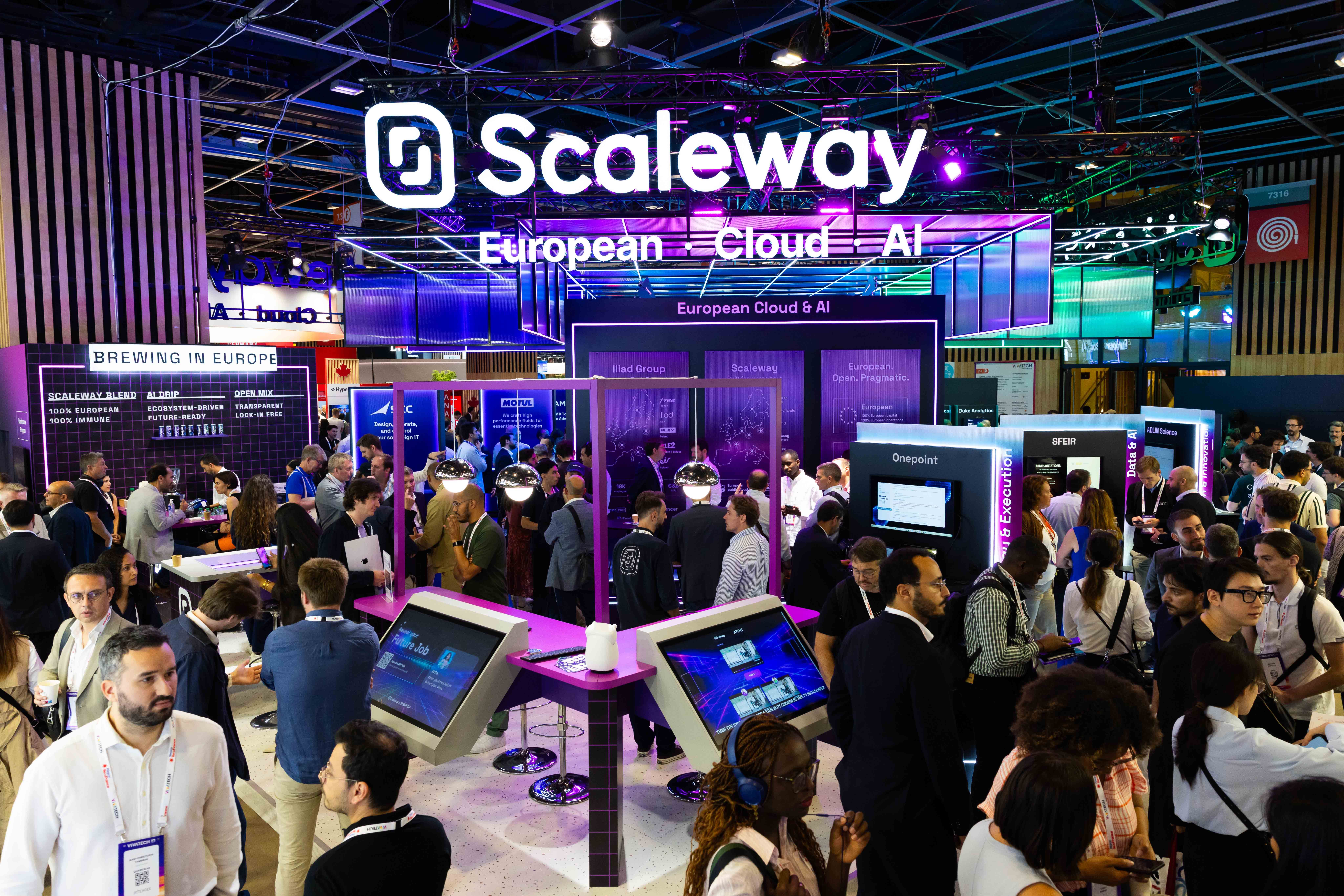
Our VivaTech 2026 Takeaways: What makes a cloud “AI-native”?
From large-scale GPU clusters to agent-ready APIs, discover the technical and economic foundations of a cloud built around AI’s demands.
In May, we officially debuted AION. Built alongside founding partners including Ardian, Artefact, Bull, Capgemini, EDF, iliad Group, and Orange, the consortium represents France’s ambitious bid under the European Union’s AI Gigafactories (AIGF) initiative.
AI adoption is driving an unprecedented demand for compute — not only for the High Performance Computing (HPC) capacity required to train models, but also for the capacity to enable inference, fine-tuning and service integration. Overall, the European AI market is projected to exceed €300 billion by 2030, growing at more than 26% between 2025 and 2030.
There’s just one problem: Europe currently lacks the capacity to power this growth. In 2025, the EU’s total installed private compute capacity (measured in datacenter IT load) stood at approximately 12.4 GW (around 20% of global capacity), representing an estimated capacity gap of almost 3 GW relative to current demand. While supply is projected to reach 42.5 GW by 2036, demand is expected to increase to 61.5 GW over the same period, creating a structural capacity gap of 19 GW relative to projected needs.
There is worse: Although there already exist multiple AI factories in the EU, each with highly performing supercomputers, “their AI-specific capacities are lower scale than many of leading supercomputers privately owned by leading AI labs and cloud providers.” In 2025, only approximately 12% of the EU-27's total data center capacity was considered "AI-ready". By 2030, “AI-readiness” could land anywhere between 35% in a slow-growth scenario and 85% in a fast-growth scenario where “major public and private investment in grid modernisation leads to substantial increases in available electrical capacity” and “national and EU-level governments prioritise digital infrastructure development” through “AI innovation hubs, tax incentives, and expedited permitting processes.”
That kind of shortage has tangible business implications.
Chief among them is cost: with limited supply rising prices for existing capacity, since 2022, average asking prices in the European colocation markets have increased by 51% for 100 kW leases. Due to a lack of available space, colocation providers were expected to raise prices by another 10% in leading datacenter markets last year.
A second consequence has to do with the performance disadvantages of high latency. Because 65% of the EU’s datacenter capacity is currently concentrated in just four hubs (Frankfurt, Paris, Amsterdam, and Dublin), businesses located outside of these areas face significantly higher latency. This degrades the availability and quality of low-latency services critical for real-time AI applications, placing local end-users at a competitive disadvantage compared to regions with better infrastructure access.
Third, the capacity shortage directly affects the ability of European companies to innovate. Prominent European AI companies and research labs have warned that the lack of datacenter capacity could become a major roadblock for developing and applying AI models in Europe. Further down the line, insufficient access limits businesses’ ability to integrate AI into their day-to-day operations.
Last but not least, the lack of capacity poses serious operational and data exposure vulnerabilities. Because local capacity is constrained and the market is dominated by a handful of non-EU providers, businesses face high systemic risks. A single failure from one of these providers can simultaneously take down critical services across multiple industries — a risk European organizations are forced to confront with each new large-scale outage.
Taken together, these risks point to the same conclusion: If compute remains scarce, expensive, concentrated, and externally dependent, Europe’s AI ambitions will remain structurally constrained. This has prompted European institutions to take action in order to accelerate the deployment of AI-ready infrastructure across the continent.
In February 2025, the European Commission announced the InvestAI Facility, an initiative to mobilise €200 billion for investment in AI, including a new European fund of €20 billion for AI Gigafactories. Interest proved overwhelming: in June, an informal call for expression of interest produced 77 proposals to set up AIGFs across 60 different sites in 16 member states. And among them was AION.
AION was formed to carry out France's bid under the EU’s AIFG initiative. Officially unveiled in June 2025 to answer the Commission’s call, the consortium has since brought in new partners, attracted additional capital, and earned extensive media coverage. With the goal of building a gigawatt of new capacity, it’s set to effectively double France’s compute capacity.
AION was designed to solve several of the most common challenges to the financing and deployment of AI infrastructure.
The first of these challenges lies in the complexity and fragmentation of AI’s value chain. In the Impact Assessment Report of its proposal for the Cloud and AI Development Act, the European Commission noted that the US hyperscalers’s ability to invest in European infrastructure — €12 billion in 2020 alone — was “underpinned by vertically integrated businesses.” Together, the 28 companies that make up the AION consortium span energy and datacenter infrastructure, cloud platforms, sovereign AI, open source technologies, industrial deployment, and financing capacity. The goal is not to replicate the hyperscaler model, but to achieve comparable coordination — bringing the right capabilities together without concentrating control.
Another significant challenge is offtake. However strong demand for compute may appear today, infrastructure builders and their financing partners need visibility on future utilization before committing capital at this scale. Without credible commitments, new capacity remains harder to finance, permit, and deploy. AION addresses this risk by bringing together a broad ecosystem of user companies that have already expressed interest in leveraging its future capabilities.
AION may be European in ambition, but its center of gravity is French for a reason.
Few countries combine so many of the conditions needed to support AI infrastructure at this scale: abundant, stable, affordable, low-carbon energy; industrial know-how in AI; top-tier education and research institutions; financial depth; political stability; and shared values.
France brings all these strengths together — and more. It’s worth highlighting two of them.
Based on the European Commission’s assessment, datacenters in the EU consumed an estimated 99 TWh of electricity in 2025, equivalent to roughly 3% of total EU power generation. Rising capacity is expected to be the primary driver of increased electricity use over the next decade.
Meanwhile, recent months have shown growing resistance to the deployment of new infrastructure, with local communities opposing new construction — largely due to environmental concerns. A report from Data Center Watch covering the May 2024 - March 2025 period estimated that $64 billion of datacenter projects had been blocked or delayed in the U.S. alone amid local opposition. And the sentiment appears to be spreading.
Together, these two factors — growing demand for compute on the one hand, and growing resistance against the infrastructure required to produce it on the other — make energy one of the decisive variables in Europe’s AI future.
France enters this equation with a clear competitive advantage. In 2025, it accounted for 12.3% of Europe’s electricity generation and exported 92.3 TWh of electricity to its European neighbors, up 3% from 2024. Crucially, France’s dense nuclear sector gives it one of the least carbon-intensive energy mixes in the world: low-carbon sources accounted for 95.2% of mainland French electricity generation last year. At a time when new infrastructure projects are increasingly scrutinized for their environmental footprint, this makes France uniquely positioned to combine scale, reliability, and decarbonization. The involvement of EDF, France’s government-owned electric utility giant, will help anchor AION in France’s low-carbon energy advantage.
In a policy brief published in October 2025, European think tank interface highlighted what it called a “peripheral innovation challenge,” where AI “factories located in regions classified as Moderate/Emerging Innovators [...] face an uphill battle without local AI expertise.” In November 2025, CEPS, another think tank, stated that: “One of the most important criterions in the selection of sites suitable for the construction of AI factories is whether those places host a vibrant AI community and can thus be defined as ‘hubs of excellence’ in AI.”
On this front too, France happens to be particularly well equipped. The country today is home to multiple leading AI organizations across research labs, model providers, robotics manufacturers, and platforms. This rich ecosystem continues to receive both ample political support and the backing of private institutional investors. It will directly benefit from the capacity made newly available through AION.
More than a bid for new compute capacity, AION is a blueprint for how Europe can build and operate AI at scale: coordinated across the value chain from energy generation to technology procurement to industrial deployment to real-world implementation.
What makes the project strategically important is how it does not treat compute as a commodity to be bought elsewhere, or AI infrastructure as a technical layer disconnected from the rest of the economy. It treats it as a shared industrial foundation: one that requires power and capital, talent and demand, to move in the same direction.
For France, AION is a vehicle for turning national strengths into continental capacity. For Europe, it is a concrete move toward the independence its AI ambitions require.
At VivaTech 2026, one question stood out: how can Europe remain competitive by building and scaling more of its technology at home?
Our executive briefing brings together the key insights from four days of discussions on cloud, AI, infrastructure, and digital sovereignty — and explores what they mean for Europe’s technology ecosystem.
Download the Scaleway Briefing: VivaTech 2026 Takeaways.
From large-scale GPU clusters to agent-ready APIs, discover the technical and economic foundations of a cloud built around AI’s demands.
The national-first model no longer fits Europe’s cloud ambitions. Meeting the demands of cloud and AI requires infrastructure built for continental scale.
Regulation has long been blamed for slowing European technology. But in cloud computing, it may prove essential to building trust and accelerating adoption.
From healthcare to public services, highly regulated sectors are increasingly embracing the cloud — and turning their demanding requirements the industry's new standards.