
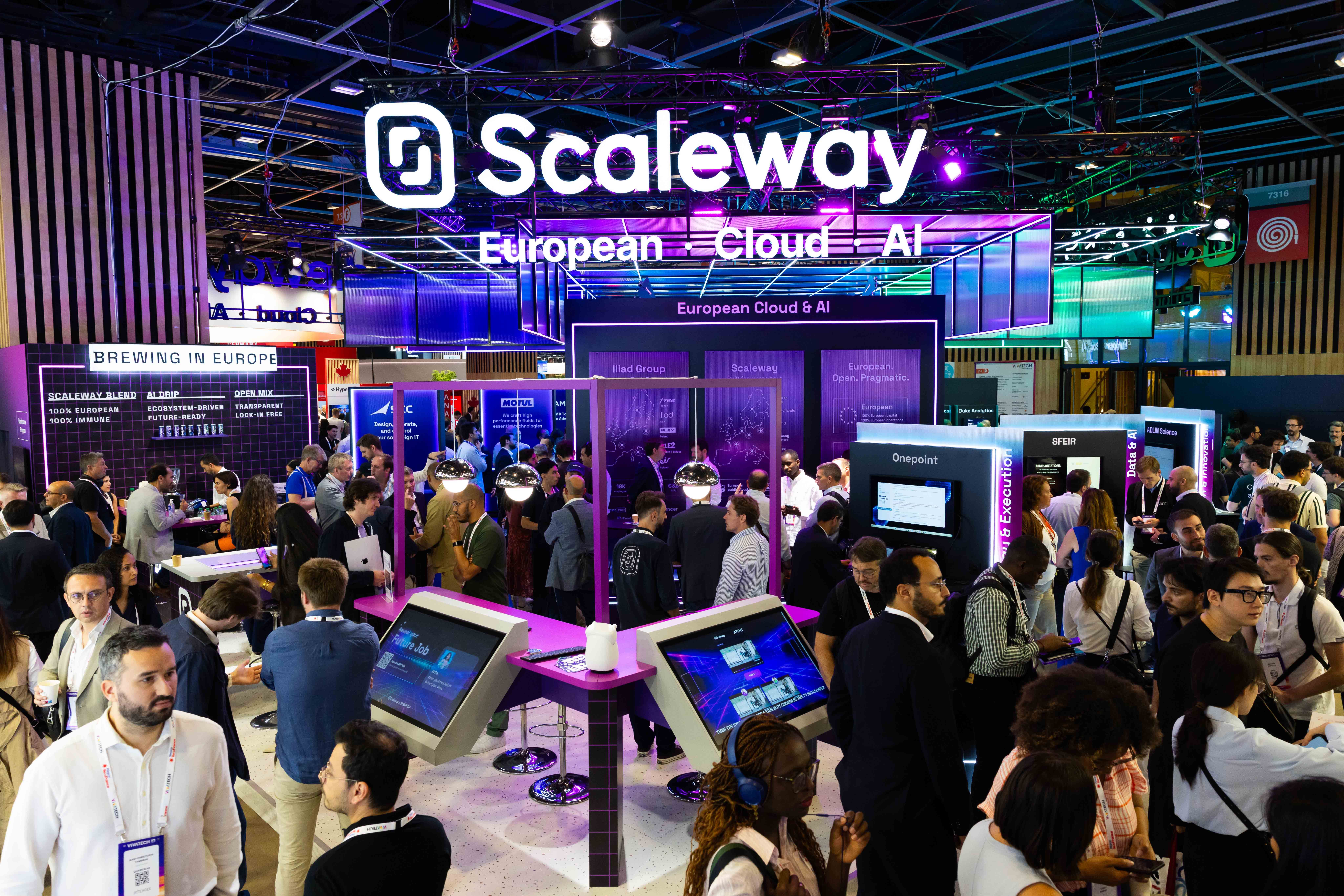
Our VivaTech 2026 Takeaways: Building at European scale
The national-first model no longer fits Europe’s cloud ambitions. Meeting the demands of cloud and AI requires infrastructure built for continental scale.
A few years ago, being a cloud provider was mostly about the same few building blocks: compute, storage, networking, databases, security, and the developer experience around them. All of that still matters. But AI changes the center of gravity.
Suddenly, some customers need thousands of GPUs connected together. Others need to process millions of tokens with low latency. Others still need to train a model, fine-tune another, deploy it behind an API, connect it to their data, monitor costs, and make sure none of this becomes a security nightmare.
So the question is not just: Can a cloud provider run AI workloads?
The real question is: What makes a cloud truly AI-native?
If you want to be an AI-native cloud, the first thing you need is compute. These days, that mostly means GPUs.
As generative tools, coding agents, and automated workflows consume ever more tokens, compute has become the factory machine you need to make it all happen.
This is why we are where we are today. At Scaleway, we invested in our first large-scale GPU cluster as early as 2023 — a lifetime ago in AI time. We were the first European cloud service provider to do so.
But having GPUs is clearly not enough.
When an AI lab uses your clusters, they are racing in a global competition where being first to launch a new model can make a huge difference. So we had to make sure we were building infrastructure they could actually rely on, not just adding more machines.
This is also why we were very glad when this work was recognized globally by SemiAnalysis in their ClusterMAX ranking.
Because in the end, AI infrastructure is not only about peak performance. It’s about performance that is available, reliable, and usable by teams that are moving very, very fast.
Having GPUs is not enough for inference either.
Sure, you can run llama.cpp in five minutes on your laptop. But running inference at scale is a very different problem.
You need APIs that stay reliable under load, along with the latency and availability that meet cloud standards. The engineering manager leading inference at Scaleway recently told me that it was the most difficult stack he had ever worked on. And this is coming from someone who has launched around ten products at Scaleway so far.
So yes, inference may look simple from the outside. But once you need to make it fast, scalable, and economically viable, it becomes a very serious engineering challenge.
There is another thing that is easy to underestimate: data.
In the end, AI is not very useful in isolation. The most valuable AI use cases happen when models can work close to your data: your codebase, your documents, your databases, your analytics, your business context.
With AI, trusting who processes your data becomes even more important. You’re not just storing files. You are sending prompts, context, sometimes sensitive business knowledge, and, increasingly, actions to be executed by agents.
This is why being an AI-native cloud cannot only mean providing GPUs or inference APIs. It also means building a fully-fledged, consistent Data & AI platform where data protection is part of the product from day one.
The other thing when you’re working on AI: you operate at a different tempo than the rest of your company.
When I said “AI time” earlier, I was only half joking. The pace of innovation in our field is intense, with new state-of-the-art models released every few weeks.
From a product perspective, this creates a very specific challenge. Most customers want access to the latest SOTA models as soon as possible. Others want long-term support so they can keep their existing workflows stable.
That means we are always deciding what to support, what to ship next, and what needs to remain stable. We have to move fast, while also keeping the same level of service our customers expect from a large-scale cloud service provider.
Token economics is also a hard problem to solve.
We are competing with VC-funded companies that can afford to lose money on every token to acquire customers, lock them in — and raise prices later.
This is not something we want to do.
So we have to be extra careful. We need to make the product economically viable not just for us, but also for our customers. Pricing needs to be sustainable from the start if we want to keep supporting the AI ecosystem over the long run.
For customers, this matters too. AI usage can grow very fast: average prompt length grew nearly 4x between early 2024 and December 2025. Agents only accelerate this trend because they can call models again and again, use tools, retry, summarize, search, write code, and generate a lot of tokens in the process.
An AI-native cloud needs to help customers innovate without turning cost into a black box.
Remember the rise of agents I mentioned earlier?
As a cloud provider, we need to prepare for it now, because agents are starting to use more and more cloud services.
Good news for us: we already follow the standards that have naturally emerged. Our Object Storage is S3-compatible. Our LLM endpoints are OpenAI API-compatible. And we have been investing for a long time in world-class documentation and CLI tools.
All of this is useful for humans, of course. But it’s also very useful for agents that need to understand and use your products.
In a way, agents make good developer experience even more important. If your APIs are consistent, your documentation is clear and your CLI predictable, and your services follow industry standards, you’re making life easier for developers and for their agents.
The real difficulty of being an AI-native cloud? All of the above challenges have to be solved simultaneously.
We need to keep investing, because our customers need increasing amounts of compute. We need to keep going faster, because competition is fierce. We need to be smart about pricing, because we are here for the long term. And we need to make sure our platform is easy to use for both humans and machines.
This reminds me of accessibility. When you make your service better by focusing on specific users, you often make it better for everyone.
The same is also true of AI-native clouds.
When you build around AI — certainly the world’s most demanding use case today — what you really end up building is simply… a better cloud for everyone.
At VivaTech 2026, one question stood out: how can Europe remain competitive by building and scaling more of its technology at home?
Our executive briefing brings together the key insights from four days of discussions on cloud, AI, infrastructure, and digital sovereignty — and explores what they mean for Europe’s technology ecosystem.
Download the Scaleway Briefing: VivaTech 2026 Takeaways.

The national-first model no longer fits Europe’s cloud ambitions. Meeting the demands of cloud and AI requires infrastructure built for continental scale.
Compute is becoming the foundation of AI competitiveness. See how AION aims to turn France’s energy and industrial strengths into strategic capacity for Europe.
Regulation has long been blamed for slowing European technology. But in cloud computing, it may prove essential to building trust and accelerating adoption.
From healthcare to public services, highly regulated sectors are increasingly embracing the cloud — and turning their demanding requirements the industry's new standards.