VPC Peering FAQ
Overview
What is VPC Peering?
Scaleway VPC Peering is a networking service that enables two Scaleway VPCs to establish a private peering connection, so you can route traffic between their resources.
This allows you to connect two VPCs - whether they belong to the same Scaleway Project or Organization, or different ones - for secure communication, away from the public internet.
Getting started
How do I peer two VPCs?
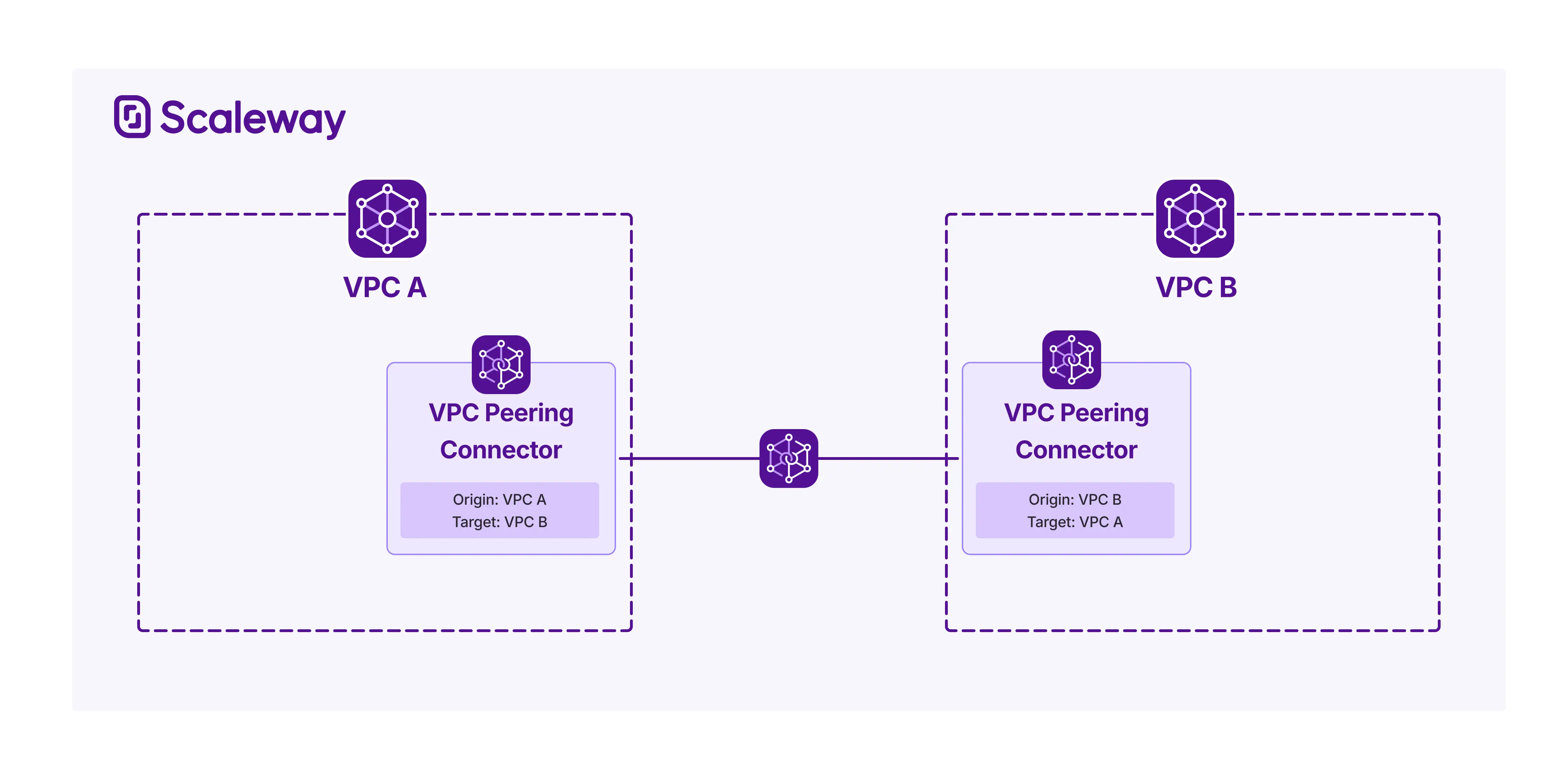
Create a peering connector, specifying a VPC you own/manage as origin VPC, and a second VPC (that you do not necessarily own/manage) as target VPC.
An owner or manager of the target VPC must also create a peering connector. In this connector, their VPC is defined as origin, and your VPC is defined as target.
When two matching, compatible connectors are created, the VPCs are automatically peered, and you can create custom routes to route traffic between them.
Compatibility and integration
Can I peer VPCs from different Scaleway Projects and Organizations?
Yes, you can. A peering connection can be created between two Scaleway VPCs regardless of whether they are in the same or different Projects and Organizations.
Can I peer VPCs from different regions?
No. Only VPCs in the same Scaleway region can be peered.
Does Scaleway VPC Peering support transitive peering?
Yes, you can chain several VPCs using peering connectors, and benefit from transitivity between up to four VPCs using custom routes. Refer to the concepts page for more information.
Access and security
What happens if someone creates a peering connector towards my VPC, but I don't want to peer with them?
This will not impact your Organization or VPC at all, and no peering will take place.
Peering connections are only established when both sides independently create a connector targeting each other. If only one side creates such a connector, the connector remains orphaned indefinitely.
If I create a peering connector that targets another VPC, does that VPC's owner receive a notification or peering request?
No. Scaleway VPC Peering does not use a request/accept model.
When you create a connector, the owner of the target VPC receives no notifications or requests. They must independently, of their own accord, create a peering connector on their side where their VPC is specified as origin, and your VPC is specified as target. Only in this way can the peering connection be established.
Pricing and billing
How is VPC Peering billed?
Billing does not start until two matching, compatible connectors are detected and enter a Peered state. Unmatched or uncompatible connectors in an Orphan or Conflict state are not billed.
Once billing begins, each peered connector is billed at a fixed hourly rate. The cost of the peering is therefore 'split' between both sides. Traffic is unlimited: no caps or rate-limits apply.
Support and troubleshooting
Why is my peering connector showing a status of Orphan or Conflict?
An Orphan status means that no matching connector has been created by an owner/manager of the target VPC. A peering connection cannot be created until the other side creates a connector.
A Conflict status means that a matching connector has been created, but the two VPCs contain Private Networks with overlapping CIDR ranges. A peering connection cannot be created until this conflict is resolved.
Learn more about troubleshooting VPC peering connector statuses.