Understanding transitive peering
Overview
Transitive peering (or transitive routing) allows two VPCs that are not directly peered to exchange traffic through a third VPC that is peered with both. Traffic is forwarded through this intermediate network, making the connection transitive.
Transitive peering is disabled by default. It must be enabled on the intermediary VPC (the VPC that forwards traffic between the two others) when that VPC is created. Only intermediary VPCs require transitive peering to be enabled, and this setting cannot be disabled after the VPC is created.
To enable transitivity, you must also define custom routes in each VPC of the chain.
For example, if VPC A is peered with both VPC B and VPC C, you can route traffic between VPC B and VPC C through VPC A. As the intermediary, VPC A must have transitive peering enabled. To route the traffic, define a custom route in VPC B directing traffic to VPC C via VPC A, and a corresponding route in VPC C directing traffic to VPC B via VPC A.
Examples
Simple peering connection
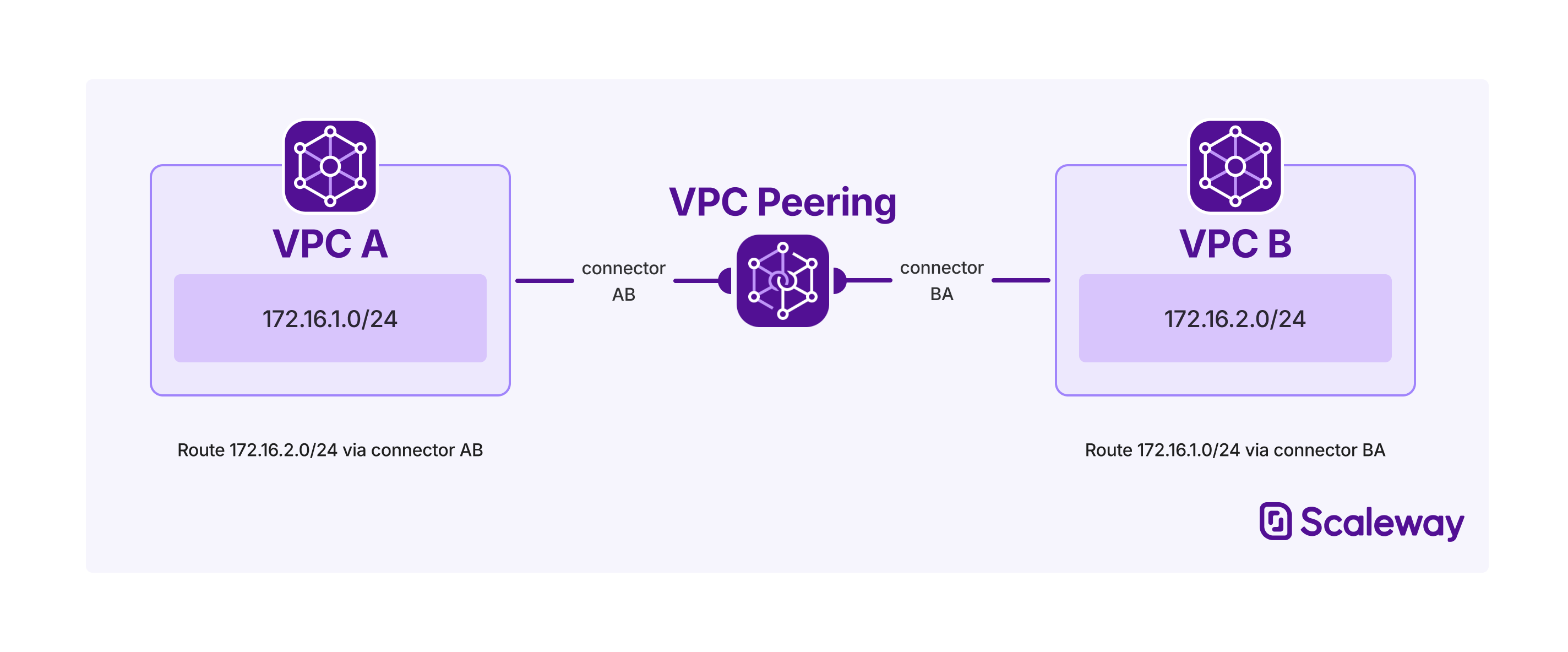
With two VPCs, there is no routing transitivity: a single VPC Peering connection is enough for VPC A to communicate with VPC B.
Three peered VPCs without transitivity
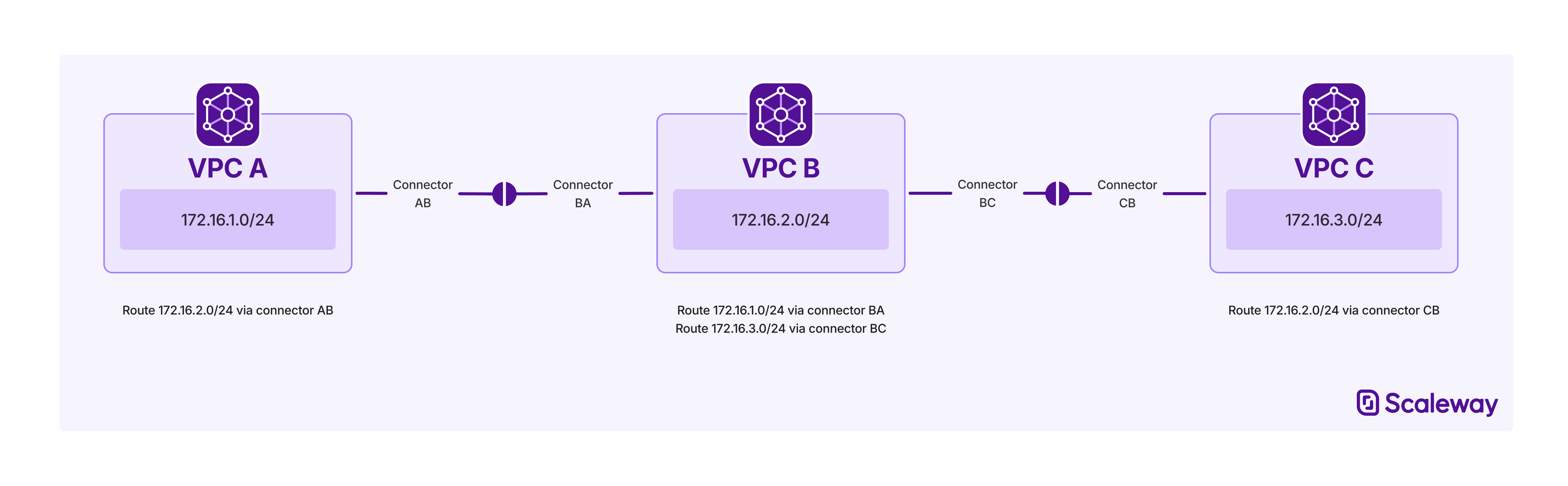
With three chained VPCs, if you only add routes related to the next peer, then VPC A and B can communicate, and VPC B and C can communicate, but VPC A and C cannot.
Three peered VPCs with transitivity
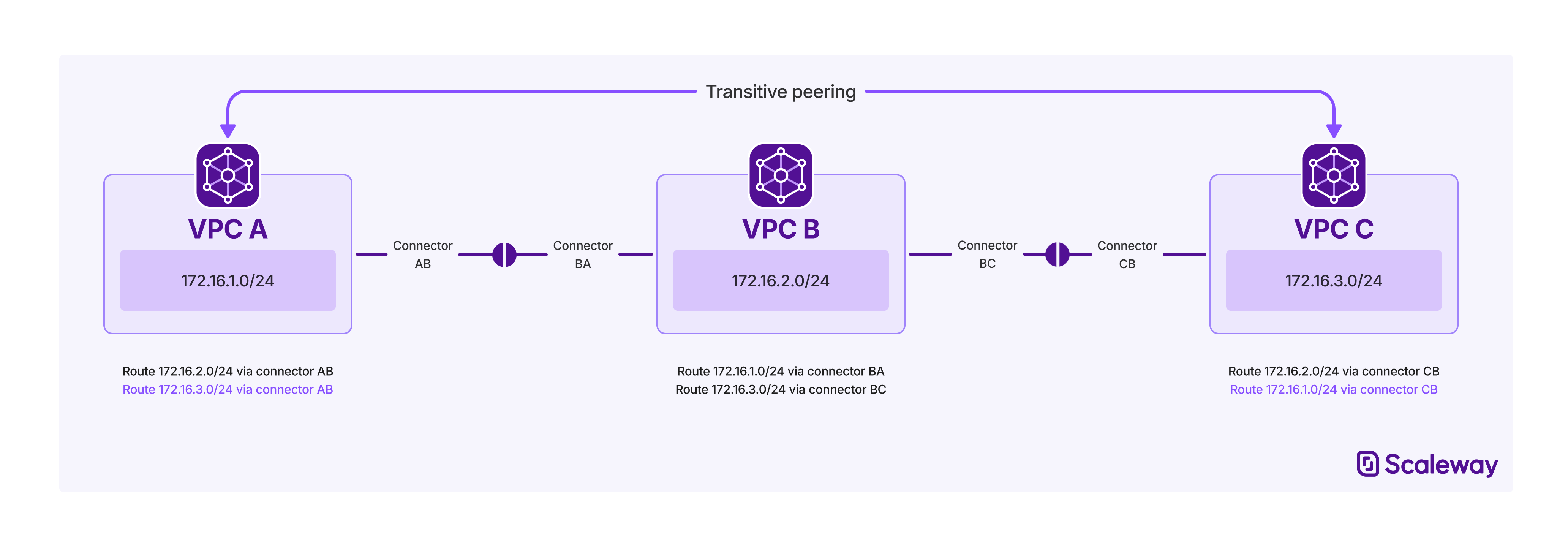
To enable VPC A and C to communicate with each other, you must add corresponding routes.
Four peered VPCs without transitivity
With four chained VPCs, if you only add routes related to the next peer, then each VPC is only able to communicate with its immediate neighbors.
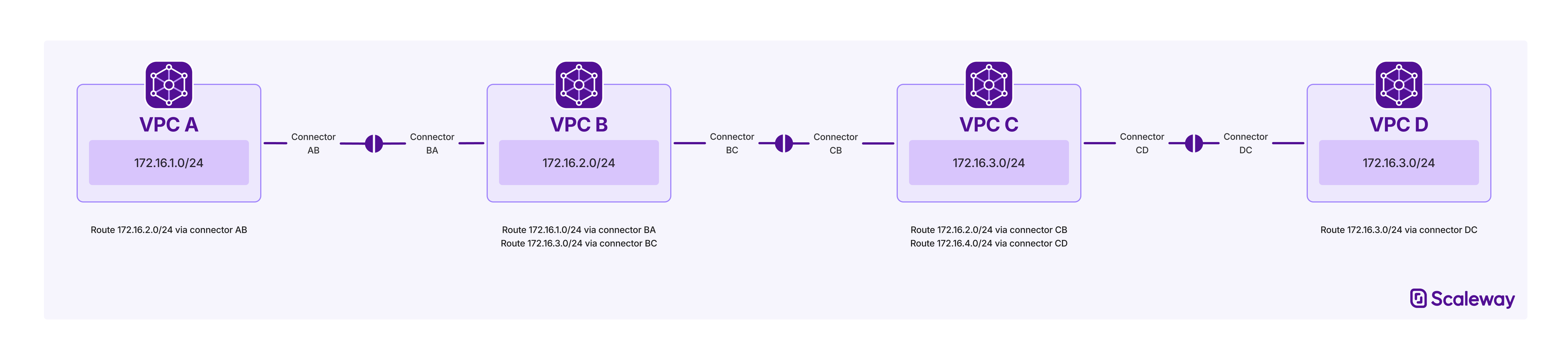
Four peered VPCs with partial transitivity
To enable VPC A and D to communicate with each other, you must add corresponding routes. This also includes custom routes in VPC B and C, which must have a path to each extremity of the chain.
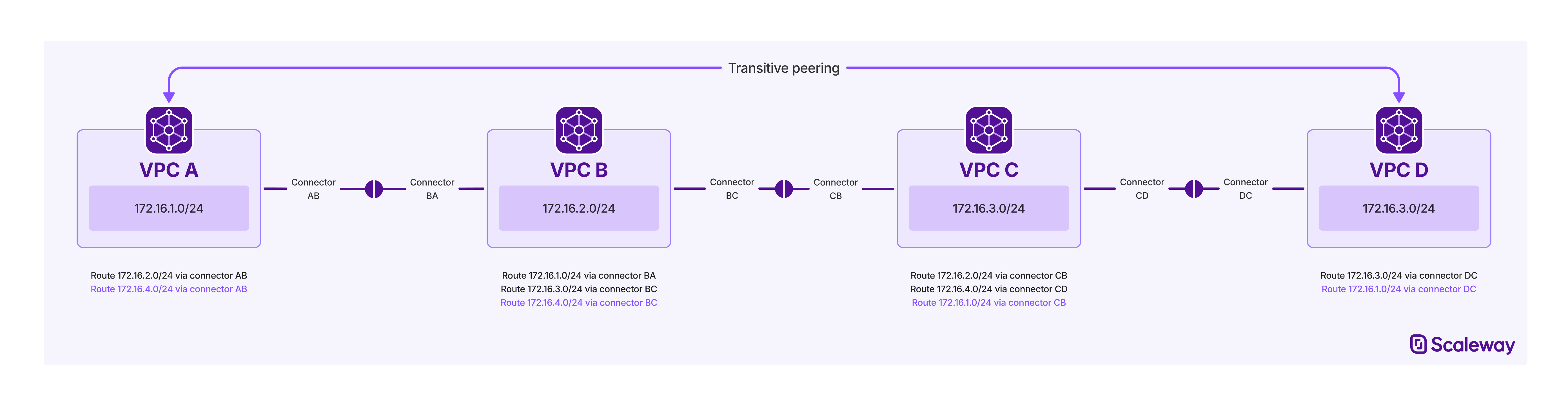
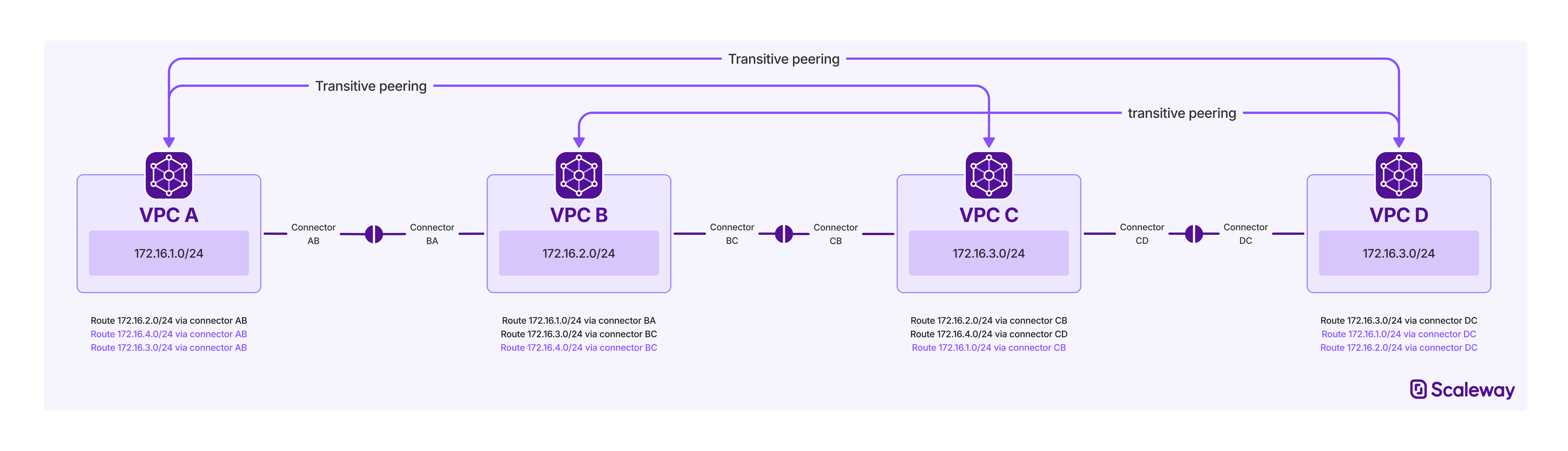
Four peered VPCs with full transitivity
To enable full transitivity and allow any two VPCs of the chain to communicate, you must add additional routes to VPCs A and D.